


Wanna Duel?
My wife has this large, leather-bound book of her family’s heritage. It contains a very detailed account of a distant relative, Peter Crawford, and an unrelated man, Thomas Burnside, who became engaged in a bitter political dispute in the latter part of 1827.
The quarrel spilled into local newspapers, billboard fliers and an accusation of cowardice aimed at Mr. Crawford’s son, George, who was Attorney General of Georgia at the time. George Crawford decided it was time to “settle” the matter by challenging Burnside to a duel, which he accepted. This was illegal in Georgia so they had to travel “by stage” to Fort Mitchell, AL to legally sort things out.
On the morning of January 5, 1828, they paced off the grounds of a popular inn, before a crowd of spectators. Each of them had a physician and a friend serving as their “second” (yeah, I know). These Cooler Heads tried to negotiate a truce but since “unimaginable” apologies were required, things proceeded as planned.
Shots rang out and both missed. Another truce was attempted—and snubbed—followed by similarly missed second shots.
After a third, more emphatic, attempt at olive branch diplomacy failed, the duel proceeded with third shots fired. Burnside instantly slumped forward. A friend sprang to his aid in time to have Burnside die in his arms.
While Mr. Crawford emerged unharmed, the “sad result was a cause of continual unhappiness” and heartbreak over the loss suffered by the wife and children of Mr. Burnside.
Not contained in the family book is this recorded note* from Mr. Burnside to his wife (available on Wikipedia and in other sources):
Dear Wife and Mother:
Tomorrow I fight. I do it on principle. Whatever may be my fate, I believe I am right. On this ground I have acted and will act. I believe I shall succeed, but if I do not I am prepared for consequences. Kiss the children and tell them that if I fall my last thought was of them.
Yours most affectionally,
Thomas Burnside
“I do it on principle. I believe I am right.” Today when we ask, “since when did we become so polarized?” we can be darkly comforted knowing that—no—none of this is new. A fairer question might be, “why does it seem we aren’t doing much better?”
Why?
Religion? Politics? It’s always those damned “Burnside” types.
Or is it?
The fact is, unpliable convictions develop from a natural human tendency, so we need to take a deep breath and assume a posture of humility and grace—toward others and ourselves.
I want to unpack a bit of neuroscience and offer a reframe we might consider as a way forward. These deeper waters will add a bit of article length; apologies, but I think it may catalyze some fresh introspection.
I’m also going to single out religious belief, only because I am personally keen to see a reworking of how we approach faith and spirituality. Nonetheless, you’ll see how these themes easily apply to political affiliation and all personal beliefs, more generally.
And this all starts—and ends—with belief.

If you’ve ever been part of organized religion, there have almost certainly been times when you felt parts of your belief system didn’t perfectly add up. You may have voiced your misgivings as questions—but probably not always freely and openly.
Existential questions are, of course, the genesis of any religion—that uniquely human desire to know what is “out there.” When someone talks about their spiritual journey, they seem to be referring to an investigative pursuit for answers to those bigger questions: Who am I? Where am I? How did I get here? Is there a God? An Intelligent Designer? How does science fit? What does it all mean? To me?
While such weighty pursuits help us form religion—or choose one—these dynamic questions slowly—steadily—fade to black, replaced by relatively immovable answers. We sometimes call them “truths.” It’s those fixed answers that we come to rely on as the idealized set of values that guide our lives. Our Beliefs.
If I told you, “I believe my homemade focaccia is the best food in the world,” that would tell you something about me, my enthusiasm for olive oil bread and maybe pique your interest in my focaccia. If I said my belief is that my focaccia is the best food in the world,” that would probably cause you to bristle. Notice the difference: Believe is a verb; a belief is a noun.
When answers to personal questions become positioned as universal answers—nouns—something dangerous happens: honest questions and conversations dry up.
Religion often gets the bad rap for its overdeveloped sense of having all the answers. But that’s not always a religion problem—nor even an answer problem—it’s a belief system problem.
Over the past couple decades, I’ve reacquainted myself with questions about my faith tradition. These range from minor head-scratchers to fundamentally significant doubts. The striking result of this change wasn’t the freedom to simply toss out some duds (though I did), but liberation from having static answers dictate my journey. Answers still have their place in the pursuit, but they are subordinated to how I currently understand things, not iron cages that lock me in.
To people of faith, this may sound fickle at first, but I find the opposite true: being less tethered to static answers continually refines and adds dimension to the questions. I can explore ideas that once seemed off limits with more curiosity and passion. If I adopt a position about something, I hold it loosely with the expectation it’s probably temporal in its current form. The shift has given way to surprising freedom, deeper understanding and broader appreciation for my and other faith traditions.
Do I still cling stubbornly to some beliefs? Absolutely. I believe that within the deepest heart of anyone’s soul is goodness. I believe that humans are wired to be connected to one another, to the earth and to the universe. I believe that love trumps everything—it always has and always will. I believe these “beliefs” are universal and true. They buttress a perspective of hope and personal orientation. Any other beliefs I might hold are likely subsets of these. But you are welcome to disagree with me.
It Comes Down to Motivation
My journey took a healthy turn because of a singular shift: motivation. I literally changed the foundational motivation behind my spiritual pursuit to question and learn, not believe and know.
Turns out, science has my back on this. It explains why we cling to religious and other beliefs with surprising ease—we want to. The mechanism, understood by researchers for decades, is called Motivated Reasoning. As good as the “question and learn” posture I noted above may sound, brain and behavioral science reveal that living that out is something altogether different—and surprisingly difficult.
Here’s how it works: you walk into my kitchen as I’m pulling my fresh focaccia from the oven. It looks and smells enticing. You’re hungry. While I artfully cut it into slices shaped for dipping into bright green, first pressed olive oil that just arrived from Italy, I explain to you how I’ve researched many different recipes over the years—trialing, testing. I mill and blend my own flour which is a mix of wheat from New Mexico and Southern Italy. You’re salivating; taking it all in.
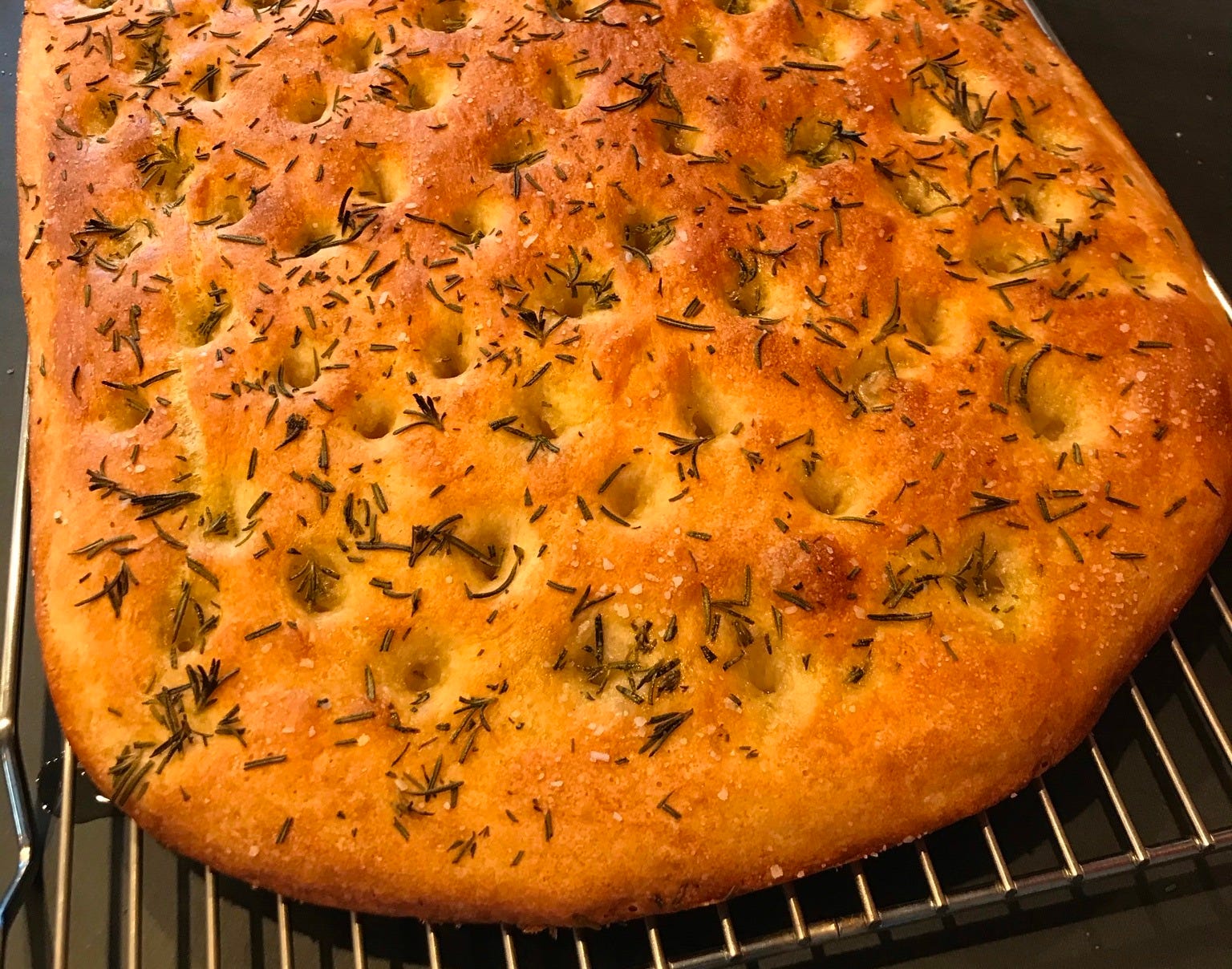
When I finally serve it, you may almost believe this is the best food in the world.
First: Motivated Reasoning guides our brains to intuitively imagine and create what “feels like” a sensible and compelling narrative about some topic. There’s virtually no thinking at this stage, just a sense of what we’d like to believe. “Wow, maybe this is the best food in the world?” That intuitive sense (sights, sounds, aroma) plants a very powerful seed.
Next: Our “reasoning" brain starts curating and interpreting data in a way that fits into the (largely preselected) narrative. The focaccia explanation sounds reasonable and supports your initial perception when you walked in the door. You taste it with inexplicable expectation.
The sequence here is the crucial point. Human evolution wired us to backfill our beliefs with data, not use data to assemble beliefs.
Warning: don’t be tempted to think some heightened objectivity elevates you above the peasantry of such motivated reasoning. Rest assured: endless research reveals that it’s both virtually inescapable and more likely stronger if you think you’re immune. Moreover, those with higher IQs are typically the most susceptible because they are better at weaving complicated data into their predetermined narrative.
You may recognize this as biased thinking. While not wrong, that term is less helpful here. The reframe of motivated thinking is much better for three reasons: 1) our feelings about “motivation” tend to be more positive than “bias;” 2) as humans, we have all sorts of motivations, so why not acknowledge them as thought drivers; and, 3) it’s easier to imagine modifying a motivation than overcoming a bias.
And motivational change is within reach.

Two Motivations
There are two general types of motivated reasoning: 1) Goal-oriented, where reasoning work begins with a particular outcome in mind (as described above and whether that goal is acknowledged or not); and, 2) Accuracy-oriented, where rational and objectively defendable outcomes are the aim, regardless of personal belief. We might restate accuracy as honest discovery. In short, there’s the “I suspect where this reasoning is going to take me” or the, “I’m going to follow this trail of questions and see where it takes me.”
This distinction can’t be overstated. I don’t know about you, but my prideful self wants to assure me I can manage these deftly. With a wave of the hand, “yes, yes…I know I am explaining my conclusion here, but that’s because I’ve already worked it out very carefully. Here, let me walk you through the process of how I arrived at my well reasoned understanding so you can arrive at it too. I mean, really, it’s so obvious!”
Sound familiar? And what’s your observed success rate at convincing or being convinced?
There is no honest merging of both motivations—goal and accuracy. Not only that, I have discovered the only way I can have a fair shot at making accuracy (or, honest discovery) my true motivation, is to completely (or as completely as I can) dispense with any hope of reaching ultimate, lasting conclusions. It’s in that space—and that space only—I can maintain a posture of curiosity and discovery; always learning, maybe homing in, but never knowing.
Everything Makes Sense
To wrap up this peek into motivated reasoning, there’s one more aspect complicating our topic of religious conviction: our brain believes first, asks questions later.
Our brains work efficiently to coalesce incoming data in a way that allows us to assemble everything together and make sense of it. In other words, any idea must come across as fundamentally believable for us to even comprehend it. Once the data stream is complete, we can then choose to unbelieve. But since unbelieving requires frustrating amounts of (literal) brain energy, we need a compelling enough motivation to set about it.
I love this example by behavioral economist and Nobel laureate, Daniel Kahneman: “white fish eat candy.” The statement is completely nonsensical. But, as you read that phrase, you could not help yourself picturing in your mind some imagery of fish and candy. Our intuitive brain strives to make believable sense of whatever we encounter—ultimately making it much easier to just go along with it.
Johnathan Haidt, psychology researcher, author and professor at Stern Business School at NYU uses a metaphor to describe our rational, thinking mind trying to control our intuitive, emotional mind. He suggests it’s like a rider on the back of an elephant. At best, the rider is “more of an advisor” than someone with real ability to steer the elephant in a particular direction.
Because a visceral belief or desire (the elephant) is so powerful, it’s far easier to go along with it than overrule it. Haidt argues that any particular data need only “plausibly” fit our belief narrative (goal motivation) to pass muster. And each bit of reason we can somehow wiggle into our narrative strengthens belief into conviction, making it increasingly impervious.
Reimagining Motivation; Restarting Hope
As you might expect, when it comes to religious belief we are highly motivated to believe the religion we are in. Difficult questions about our religious beliefs make us squirm because they ask us to re-evaluate stones we’ve previously set in place, threatening the whole structure. I remember someone at my old church saying to me once, “you can’t pull on that thread, Dan, because if that’s wrong, the whole thing will unravel.” I recall thinking that if it can’t stand up to scrutiny, it can’t stand up to time. Ask Galileo.
But all this unease is only because we want and expect to have the answers. That’s the motivation. When we want and expect to gain new understanding—by leaning into good questions, wherever they may lead us—that defines a very different motivation. In this paradigm of discovery, what we “know” is something in a constant state of emergence. I see no good reason to settle for anything less.
And, if we remind ourselves that spirituality broaches topics of (literally) cosmic proportion, might it be bit arrogant to think we can really have all the answers? Changing our motivation to [pursuing] accuracy, we are ironically far more likely to get steadily closer to those answers we crave to know, yet are doubtful to ever fully comprehend.
Where do you want to go with your spiritual pursuit?
How do you want to travel?
Who do you trust to share your journey with?
What’s your motivation?
* Interestingly, the date of the letter (January 24, 1828) attributed to Burnside writing his wife postdates his death of January 5, 1828. It was reported that Burnside’s wife did not receive news of her husband’s death for 2 weeks “and almost died herself.”
Relevant reads:
Thinking Fast & Slow, Daniel Kahneman
The Happiness Hypothesis, Johnathan Haidt
Think Again: The Power of Knowing What You Don’t Know, Adam Grant
How to Read the Bible, Harvey Cox
Dan Parodi is a badge-carrying executive coach. This series on spirituality is consistent with his other topics that urge reflection on the more meaningful parts of life. It’s easy to get distracted from the life-path we want, so hopefully these trigger deeper, personalized consideration…and maybe action?